Sunday, February 15, 2015
So much procrastination. So little time.
I have deliberated over whether or not to use my freebie this weekend. This really seems like a valuable exercise, and I kind of hate to miss it! I planned to use this today because I was going to be swamped with all the preemptive work I was going to do. But now, not only have I wiled away my preemptive work time, but I am also still not doing my blog post! Senioritis is not the fun, carefree sickness I though it would be.

Saturday, January 17, 2015
David Holt: The joyful tradition of Mountain Music

Video URL:
Summary:
The joy of Music is a powerful force. It can bring people together, and keep them going through hard times. In this talk, David Holt told several stories from his life and from the Appalachian musical culture that demonstrated this point.
Holt’s love of music started on a hot summer day in 1954 in Gatesville Texas. His brother, mother, and him were driving in the car, and the boys were furious with their mom. She didn’t let them get the jar of Ovaltine they wanted at the grocery store, which had a toy attached. Their mom was scolding them, telling them how ungrateful they were and how “money doesn’t grow on trees”. Determined to teach her sons some work ethic, she pulled the car over to one of the cotton fields they had been driving past. She told the foreman: “I've got these two little boys, never worked a day in their lives.” So she asked the foreman to put them to work picking cotton and filling up a ten foot sack, alongside the hundred black workers in the field. He did as he was asked, and the boys worked all day picking the prickly, painful plants. At first they cried to their mother, who watched with an uncompromising gaze. Trying to ease their discomfort, the foreman snuck up behind them and began to sing an uplifting tune: “good news good news, a chariot’s a comin’”. The field of workers joined in, and the boys stop complaining as they were surrounded by these beautiful songs. This showed how music can make hard work a bit easier, and how it can bring a group of people together, in a unique way.
About 15 years later, while attending the University of California at Santa Barbara, Holt attended a concert by Ralph Stanley, a famous banjo player. After seeing it in action, Holt fell in love with the African claw-hammer banjo technique. He sought out Stanley after the concert and asked how he could be involved with that kind of music, and Stanley told him to go to Asheville, Clinch Mountain, or anywhere where there is a lot of music. There will be old people still playing that style. So he went, and fell in love with the culture and people. He met people living with no electricity or running water, but who carried on the traditions of Appalachia through their storytelling and music.
One such person was Aunt Zip, from Sodom, North Carolina. She was 105 when he met her, and together, they sang a song that she had written. She didn’t have much energy left, so he led her in the call: “Hey Hey” and she would give the response: “Black-eyed Susie”. On her small farm, her grandson was tilling the fields with the mule, and Holt and Aunt Zip sang together. People like this embodied the persistent joy that comes from this music of the mountains. When he came back home, he finished his two degrees in biology and art, and told his parents he wanted to be a banjo player.
Later on, this same joy from music saved Holt’s life. 15 years ago, he and his wife lost their daughter, Sarah Jane, in a car accident. After this immense loss, Holt was just barely hanging on. He was staring into the abyss, and desperately searching for reasons not to jump in. He started making lists of reasons to stay in this world. He started with the big things: his son, wife, and parents. But after this, only seemingly insignificant details were added to his list. Things like seeing the daffodils bloom in the spring, the touch of a baby’s hand, and finally, the sound of the steel guitar. This was the only instrument that could fully convey the emotion he was feeling. A blues tune on his steel guitar arose from his sadness, and it was the music he immersed himself in that got him through this hard time.
Holt closed out his talk by talking about the lighthearted things of his life; childhood stories, experiments, and games. He finished his speech by showing the audience a device he had made with the advent of drum triggers. He took a full body suit and sewed in 12 different pressure sensitive drum triggers. He played ancient hambone rhythms on this unique, hilarious looking instrument, slapping his thighs, arms and chest to create an immersive sound. The talk ended with this “thunder-suit” solo, and the audience’s laughter and cheers.
Analysis:
Purpose:
Although this TED talk wasn’t necessarily meant to do anything more than inform and entertain the audience, for the purpose of this analysis, I will view the tactics used in Holt’s talk as tools to persuade the audience to see the power of music. This was likely an underlying motivation, but it was never explicitly stated.
Ethos:
David Holt is a four time Grammy-winning musician, who plays ten acoustic instruments and hosts radio and television shows on early American folk tales and music. These amazing credentials give Holt more than enough authority to talk about the subject of mountain music. However, these are not explicitly stated in his talk, so Holt finds other ways to establish credibility. He does this primarily by demonstrating the music connected to his stories throughout his speech. He treats the audience to several songs, playing the steel guitar, harmonica, banjo, and singing beautifully. By interjecting real snippets of the Mountain Music he is talking about, he establishes his expertise on the subject of Appalachian music. His personal examples and stories also display his proximity to and in-depth understanding of the effect of music on people. You can talk about the beauty and influence of music until the cows come home, but if you don’t have a lick of musical ability, it’ll be far more difficult to establish authority on the subject.
Logos:
The main purpose of these stories was to show how music can get people through hard times and bring people together. Consequently, an emotional appeal will be used the most often to prove this point. However, throughout his speech, Holt uses a few logical approaches to further his argument. This is found mostly in the use of specific examples. As in any argument, it is important to back up theoretical ideas with specific real world examples. Holt does this by displaying the positive power of music by telling tales of the effect of music on his childhood, in his adult life, and in the lives of Appalachian people. However, the majority of the examples were experienced by him personally, a professional musician, and therefore interpreted through a pro-music lens. Holt’s argument might've been enhanced by a brief historical exploration of the effect of music on the culture of Appalachia, or the biological effects of exposure to music.
Pathos:
Music is inherently emotional, triggering the release of neurotransmitters like dopamine throughout the brain, which causes an visceral emotional response. Therefore, an emotional appeal was the most common appeal used by Holt in his stories. He played music throughout the talk to display the emotional effect of music. But he also used emotional examples to convince the audience of music’s positive effects. From humorous stories of his childhood to the sadness he experienced following the death of his daughter, Holt shows the influence of music on the wide range of human emotion.
My Connection:
I chose this talk because I have always enjoyed bluegrass music. This interest in the music of the Appalachian mountains started at my grandparent’s house. Every Friday night that we stay at their house in Warrensville, NC, we go down to Phipps Store to listen to some of the best local pickers. Not nose pickers, but pickers of the mandolin, banjo, dulcimer, etc. We sit in the small crowd listening to the impromptu jam sessions, and watching people clogging to the beat. The culture found in these old, rolling mountains is fascinating, and has given birth to one of the most popular America genres of music, bluegrass. Originally played on makeshift fiddles and banjos, this music has offered people living in the mountains an escape and creative outlet for centuries. I love Holt’s professional mission: to preserve this musical tradition; it was an influential chapter in America’s musical history, and it deserves recognition and appreciation.
Sunday, December 7, 2014
"Come, you spirits-- Netflix me here"
Watched
by Lady Macbeth:
House
of Cards:
 |
| Claire Underwood, played by Robin Wright. "Out damned spot!" (Macbeth) |
In this political masterpiece, the South Carolina
senator Frank Underwood maneuvers his way through the top American bureaucracy:
Congress. With each ethically questionable decision he makes, he gains more and
more power. His wife, Carrie Underwood is an equally influential person in the
D.C. area. She supports him every choice he makes, pushing him to make the most
of his position to gain more influence. Though he would never admit it, most of
Frank’s decisions are influenced by his wife's encouragement and convincing
arguments. Lady Macbeth has truly enjoyed watching Carrie playing a powerful
role in American politics, while at the same time maintaining conventional
gender roles, working through her husband's image. By her own admittance, she
is often guilty of shouting: "Thoust goest girl!" at Claire
Underwood's influential and clever words. She has a way of planting vaulting
ambition in the heart of her husband. This ambition will increase his power,
and consequently, her influence and status. Lady Macbeth loves it, and has
gotten a few ideas for her own marriage from this show.
Madmen:
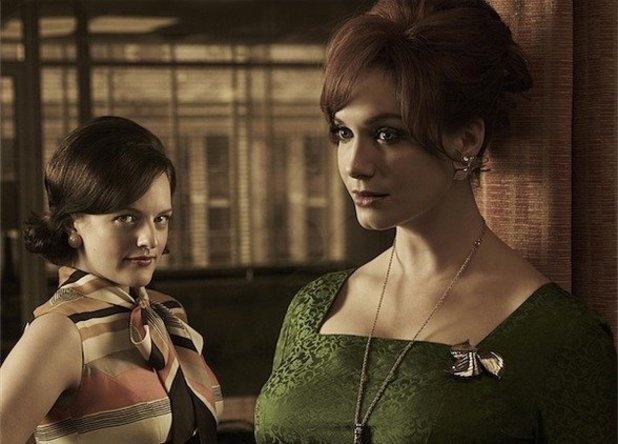 |
| Peggy Olson, played by Elizabeth Moss, and Joan Holloway, played by Kristina Hendricks |
In the bustling, cut-throat world of 1950's
advertising, Madmen follows the journey of creative genius Don Draper. The
agency he works in is filled with alcohol, tobacco, and sexism. The women
working there are constantly subjected to shameless objectification by the male
copywriters of the office. Most woman work as secretaries and phone operators;
there is very little mobility for women. There are two powerful exceptions,
however. Peggy and Joan defy the gender roles of the office in their respective
positions, and they struggle with being viewed as masculine because of this.
Watching their journey through a sea of power-hungry men is inspirational for Lady
Macbeth. She is able to see the progression of feminine influence in the
office, and she empathizes with the conflicts of these two characters
especially. When Peggy is accused of being masculine, she cringes: she's been
there before. But when Peggy and Joan triumph over the stigmas against women,
she rejoices. A powerful, influential woman like herself has a chance to
increase in status as a result of her own actions.
Frozen:
 |
| Elsa, voiced by Indina Menzel |
Lady Macbeth hates snow, but she loves this movie.
Frozen is the story of Elsa, a powerful queen who must hide her true identity.
Finally, when her powers are revealed, she runs off into the mountains of the
Netherlands, to fully realize her potential. She sings "Let it Go",
an anthem broadcasting release of her fantastical powers. However, this
expression of power eventually hurts her younger sister. She is struck by a
release of ice from Elsa, an unintended side-effect of her personal liberation.
Elsa then deals with the immense guilt of this event; she must redeem herself
of her sister's sickness. Lady Macbeth deals with a similar guilt. She fully
understands Elsa's expression of power through her actions and the consequent
guilt when things go too far. She loves the redemption Elsa receives at the
end, and she hopes that she too can be free from guilt. Maybe the snow can wash
away her stains as well.
The
Hunger Games
 |
| Katniss Everdeen, played by Jeniffer Lawrence |
Based off of the extremely popular series by Suzanne
Collins, this movie follows the life of Katniss, a girl from district 12. She
volunteers to be a part of the “Hunger Games” a government organized game that
forces 24 young people to fight to the death like teenage gladiators, and only
one emerges as a victor. Throughout the games, we see Katniss struggle with
fear, murder, and consequent guilt. Katniss works with her significant other,
Peeta to win the games. In the end, they are the only two “tributes” left.
Instead of killing each other, they both choose to commit suicide together.
This act of devotion stops the games, and they are both victors. Lady Macbeth
loves the love story of this movie; she can’t get enough of the Katniss, Peeta
dynamic. But she especially sympathizes with their situation. They are both
working together to kill off their opponents, one by one. The guilt of their
deaths slowly builds, but they simply can’t go back until they are unopposed.
In the end, they choose to end their misery in death.
Sunday, November 16, 2014
Mawiage Is What Bwings Us Togeva Today
Big things are happening today, a question is being asked. It's cray over at the McClure household, so I'm gonna take a FREEBIE!
P.S.
The question starts with "Will you" and ends with "Marry me"
My Sister is involved so is her boyfriend.
P.S.
The question starts with "Will you" and ends with "Marry me"
My Sister is involved so is her boyfriend.
Sunday, October 26, 2014
Limited Visibility
 |
| 89 Huicholes, 2006, By Santiago Sierra. 84 black and white portraits. |
Initial Response:
Limited
Visibility is an exhibit that emphasizes the effect and meaning behind
intentional erasure and omission. The manifestation of these absences varies in
each work, and the purpose behind the omission has different intended effects
on the viewer. The Curator’s
statement explained this exhibit’s
impact: “Seer, seen, and unseen come together here to evoke the haunted
sensation of searching and looking.” With the curator’s introduction as a guideline for my
thoughts, I was able to search for the omission of each piece, and ponder the
significance of absence.
Each
work’s omission gave me
unique feelings. 97 Housemaids, by Daniela
Ortiz, showed pictures collected from Facebook that centered on upper-class
Peruvian families. The maids and workers were cut out or in the background. Though
not intentional, the pictures depicted a heart-wrenching truth about the
relationships between different social classes. Other works were less
straightforward and required personal interpretation. A site-specific piece, Unfolded Architecture by Pablo Rasgado,
showed a square of deconstruction. The omission of the sheetrock and plywood
didn’t have a clear message,
but it stirred in me a feeling of loss and impermanence. But perhaps the
destruction of the old is necessary for the advent of the new. Other pieces had
absent ideas, like the missing labor in Allora & Calzadilla’s sandpaper composition. This could
represent a seeming disregard for the months of work the sandpaper was used
for. Each piece had a unique message and a clear theme. “Limited Visibility” was
a straightforward, but at times challenging concept. As an art novice, I was
excited and surprised by the ideas I gleaned from things that were missing.
Visual Analysis:
The
piece that I have chosen to analyze is a collection of 84 black and white
photographs by Santiago Sierra. It is called 89 Huicholes, and was made in 2006. Santiago is an artist from
Spain, and many of his works express some sort of message for social change. In
this piece, Santiago has compiled 84 portraits of members of the Huicholes
tribe. These photographs, however, defy the conventional portrait form. The
members of the tribe all have their backs to us. We can see the occasional
neck, headdress, and hair, but their faces are hidden. Most portraits emphasize
the face as the defining feature to be depicted, but Santiago views the back,
or omission of the face as a significant representation of the individuals.
These portraits are all similar, most with only one subject, but a few with an
unseen mother and child. They are all depicted in black and white. This lack of
color works to draw the attention to minute differences between each picture.
Without distracting colors, the viewer is not overwhelmed by the display, and
is able to analyze each individual. Each picture is in portrait orientation,
and they are organized into 5 rows. The four top rows each have 17 pictures,
but the bottom most row has only 16; there is an empty space in the bottom
right corner. This is another example of purposeful omission, in line with the
theme of the exhibit.
In
a society that highly values image and exposure, this piece is a culture shock.
Viewing pictures that purposely omit the face is surprising, and extremely
impactful. Even as we perused the exhibit, phones were out, pictures were being
snapped and instantly posted. To look in on the starkly contrasting culture of
the Huicholes is humbling. One of the last tribes in North America who still
practice their pre-Columbian traditions, the Huicholes are constantly fighting
against the government and farmers to maintain their religious practices and
ancestral land rights. By having their backs to the viewer, this piece invokes
a sense of guilt. Perhaps this is the only thing we ever see of the Huicholes,
we live in ignorance of their existence. Could these pictures represent the
highest level of exposure that their conditions and culture will ever receive?
Even
from behind, we can see that the subject of each portrait has a unique
personality and attributes. This is seen in the way they choose to organize
their hair, headdresses, and clothes. Their body position may indicate their
psychological or physical condition. The viewer is forced to utilize what they
are given to form a complete picture of the individual. Santiago describes
this: "The person has to create what the person doesn't see". The
viewer is not spoon-fed the picture, they instead must actively pursue the
image of the individual. Without the face of the subjects being shown, only so
much can be assumed about them. Although the viewer is keenly aware of the
subject's individuality, they can't truly know the person from the light that
has been captured and displayed. This may represent the tragedy of the
unnoticed, unseen. There are people around the world that are unique, special,
in need of help, but never noticed. They are never given the opportunity to
communicate, be seen, and shown. The Huicholes are in this condition, and
Santiago displays this in 89 Huicholes.
We need to notice those being oppressed and silenced. We should take a break
from absorbing the publicized, and instead actively pursue the things not being
shown. By seeking out those whose backs are turned, we can have a positive
impact on their lives. By changing our mentality, perhaps we can alter the
culture to pursue engagement and active pursuit; as opposed to inactively
viewing the things we are shown.
The
empty space in the bottom right corner of this work is another purposeful
omission by Santiago. This space is perhaps meant to be filled by the people
the viewer knows that are ignored. Individuals or cultures that are bypassed
and oppressed, or maybe even the viewer him/herself feels that they would fit
in this space. The empty space allows the message of the work to go beyond just
the Huicholes. This ignored identity is seen around the world; the oppression
of the Huicholes is an example of this universal principle. As I viewed this
piece, I thought of the people I ignore and dismiss, and even those who I have
never met or heard of, and I added them to this gap.
Saturday, October 18, 2014
Pride in Advertising
 |
| Buik Reatta advertisement, published in Sports Illustrated, June 13th. 1988 |
Denotation:
This
advertisement from General Motors is promoting a Buick Reatta car. The car
itself is bright red, gleaming, and highly glossed. With a black racing stripe
down the center, aerodynamic design, and two doors, it seems like a sports car.
It stands in stark contrast to the black background it is framed in. Above the
car are the words “Go Ahead. You deserve it.” These are prominently displayed
in all capital letters, in a bold font at the top of the advertisement. Below
the car are the “specs” of the model. These are titled by the name of the car,
“Reatta”, written in a sleek, smooth font. The details of the car itself and
the short note to the audience of the advertisement are written in bright red
letters, matching the car. The details of the car’s attributes are presented in
a bulleted list, and are framed by flattering messages to the audience at the
beginning and end. Underneath the specks is the company name, Buick, written in
bold, red letters as well. Below this is a company slogan and logo, red to
match the rest of the ad.
Connotation:
This
advertisement appeals to the deadly sin of pride. The first words seen justify
self-indulgence: “Go ahead. You deserve it”. At the top of the ad, they are prominent and
bolded; hard to miss. The advertisers use these words to frame the car
underneath as a tempting treat to be taken. The car itself is sporty, sleek,
and attractive, but largely impractical. The advertisement acknowledges the flash
and impracticality of the car, but by elevating the self-concept of the
audience, the audience feels validated in buying the Reatta. The font of the
car name, “Reatta” is smooth and sleek. This reinforces and emphasizes the
sporty nature of the car. The main text of the advertisement works to persuade
the audience that they deserve this car. The first line appeals directly to
their pride: “Like many people of achievement”. It goes on to tell the audience
that they have passed up on many pleasures in life to get to where they are
now. “If so, this is your time- and Reatta is your car”. After describing the
viewer as a successful, self-sacrificing person, they tell the audience to
reward themselves for their excellence. The bulleted list following this outlines
the attributes of the car. It describes a Buick that is worthy of a deserving
driver. Throughout the text and in the slogan at the end, “American” is
carefully placed. A patriotic, high-achieving, and motivated person like
yourself deserves this fantastic car.
Audience:
Published
in a Sports Illustrated magazine in 1988, this ad’s target market was likely
middle-aged, upper-middle class, American men. This demographic is often
searching for something to do with their extra time and money. Eric Erikson
describes this pivotal period in his stages of psychological development. He
asserts that during this period, people begin to use their leisure time
creatively, and reinvent their roles in society. The advertisers are catering
to this psychographic: “You’ve probably postponed some of life’s special pleasures
on your way to where you are. If so, this is your time.” They are offering them
an appealing way to spend their newly freed up money and time. The audience of
this ad is likely familiar with advertisements that appeal to the functionality
and practicality of products. They are mature enough to see through many
tactics used to disguise products as useful and practical. Consequently, the
advertisers are openly presenting the car as a luxury vehicle. Though not
necescarilly functional, it is something the viewer deserves.
Saturday, October 4, 2014
Charlotte Bronte and Jane Eyre
 |
| Jane Eyre Dress Rehearsal- Act 1, Hessle Theatre Company, taken by John Drury |
"Such
is the imperfect nature of man! Such spots are there on the disc of the
clearest planet; and eyes like Miss Scatcherd's can only see those minute
defects, and are blind to the full brightness of the orb," (Bronte 62).
By focusing on remedying the
imperfect nature of man, the teachers of Lowood at the command of Mr.
Brocklehurst spend all their days picking apart the sinful actions of their
students. Trying to punish for imperfection, they are forever focused on the
bad, however minuscule, and the miss the value of the individual. The central
idea Bronte is trying to communicate in this passage is that cruel treatment,
even when justified by religion, can be extensively damaging for individuals.
The injustsice of Brocklehurst's treatment of the girls is seen in the
extremity of their conditions and punishments, the disparity between the girls’
conditions and the conditions of Brocklehurst's wife and daughters, and
Brocklehurst's lack of forgiveness.
"I have a Master to serve
whose kingdom is not of this world: my mission is to mortify in these girls the
lusts of the flesh; to teach them to clothe themselves with shame-facedness and
sobriety," (Bronte 59). Brocklehurst's aim is righteous upon initial
inspection. However, the way in which he goes about this involves cruel and
vicious tactics. Bronte recounts the awful treatment of the girls in the first
few paragraphs. They are given minimal clothes to shield from the cold, barely
enough food to survive, and are punished cruelly. These methods are meant to starve
the body but feed the soul, but they instead result in the starvation of these
girls physically and emotionally, and probably the rejection of any God who
would allow such treatment.
The true hypocrisy of
Brocklehurst's mentality is exposed when his wife and daughters are introduced.
While Brocklehurst is explaining to Miss Temple the shameful extravagance of
the girls braided hair, Brocklehust's family interrupts. Three ladies walk in,
wearing expensive curls, embroidered gowns, and rare furs. By introducing this
situational irony, Bronte is able to comment on the hypocrisy of Brocklehurst
and the horrible disparity between religious idealism and the true actions of
many practitioners. The stark contrast between these two conditions reaffirms
the horror of the conditions in Lowood.
Though Brocklehurst claims to
follow the tenants of Christianity, his practices are directly opposed to the
purpose of Christianity. His lack of forgiveness towards Jane or any of the
students shows his ignorance in true Biblical mercy. "For it is by grace
you have been saved, through faith-- and this is not from yourselves, it is the
gift of God--" (Ephesians 2:8). In the fundamental Christianity by which I
have been raised, it is essential that this verse is realised in everyday life.
Brocklehurst's attempt to reprimand and fix the girls in order for them to
achieve salvation is in direct opposition with this verse. As he strives to
right all their wrongs, with no forgiveness, he misses that grace and salvation
come from Christ alone.
Brocklehurst and Lowood's
teachers are forever focused on the imperfection of Jane and her peers. Instead
of depending on the salvation offered by the grace of God, they strive to earn
salvation for the girls by making them live righteously. Bronte points out the
horror of Brocklehurst's treatment, which seems to be justified by
Christianity. Focusing on the sins of man will forever focus attention on what
is wrong, without recognizing and utilizing all the things that are right.
Works Cited
Bronte, Charlotte. Jane Eyre.
London: J. M. Dent & sons Limited, 1908. Print.
Drury, John. "Jane Eyre Dress Rehearsal- Act 1." Hessle Theatre Company. N.p., n.d. Web.
4 Oct. 2014. <http://www.hessletheatre.co.uk/Productions/JaneEyre2011/JaneEyreDressRehearsalAct1.htm>.
Subscribe to:
Posts (Atom)