Saturday, March 14, 2015

The American Dream

1. How would you describe the “American Dream?”

            The American dream embodies itself in many different ways. However, when I hear the words “American Dream”, I can’t help but think of an idealistic, picturesque lifestyle. There is a small white house with green shutters in a quiet, suburban neighborhood.  An old oak tree shades the front lawn, complete with a small tire swing. A substantially large city is about 25 minutes away, where my family and I go on the weekends to spend our hard-earned money, stimulating the local economy.  There’s a diverse, effective school to send the kids to, and a church to get involved in. This kind of white picket fence environment is not universal throughout America, but the guiding principles that allow for this lifestyle are universal. America’s founding documents allow for a capitalist economy, freedom of religion, and free education, to name a few. Therefore, in my view this American dream is allowed because of the freedom provided by democracy. The ability to freely express ideas, practice religion, and elect our leaders allows American citizens to build a life that suits them, and it will hopefully allow me to live in this small suburban home one day!

2. What is your definition of wealth?

            Money. Material gain. How many yachts you have. These things describe wealth. By this measure, I am far from wealthy. My two door ’96 Honda civic doesn’t constitute a fancy sports car, and my savings account is abysmally empty.       
             That was mostly a joke. I believe wealth is more effectively measured by another metric. It should be defined in a non-materialistic way; a measure of the depth of relationships one has and the meaning of one’s life. According to this concept, I am relatively wealthy. Maslow described this idea in his “hierarchy of needs”.
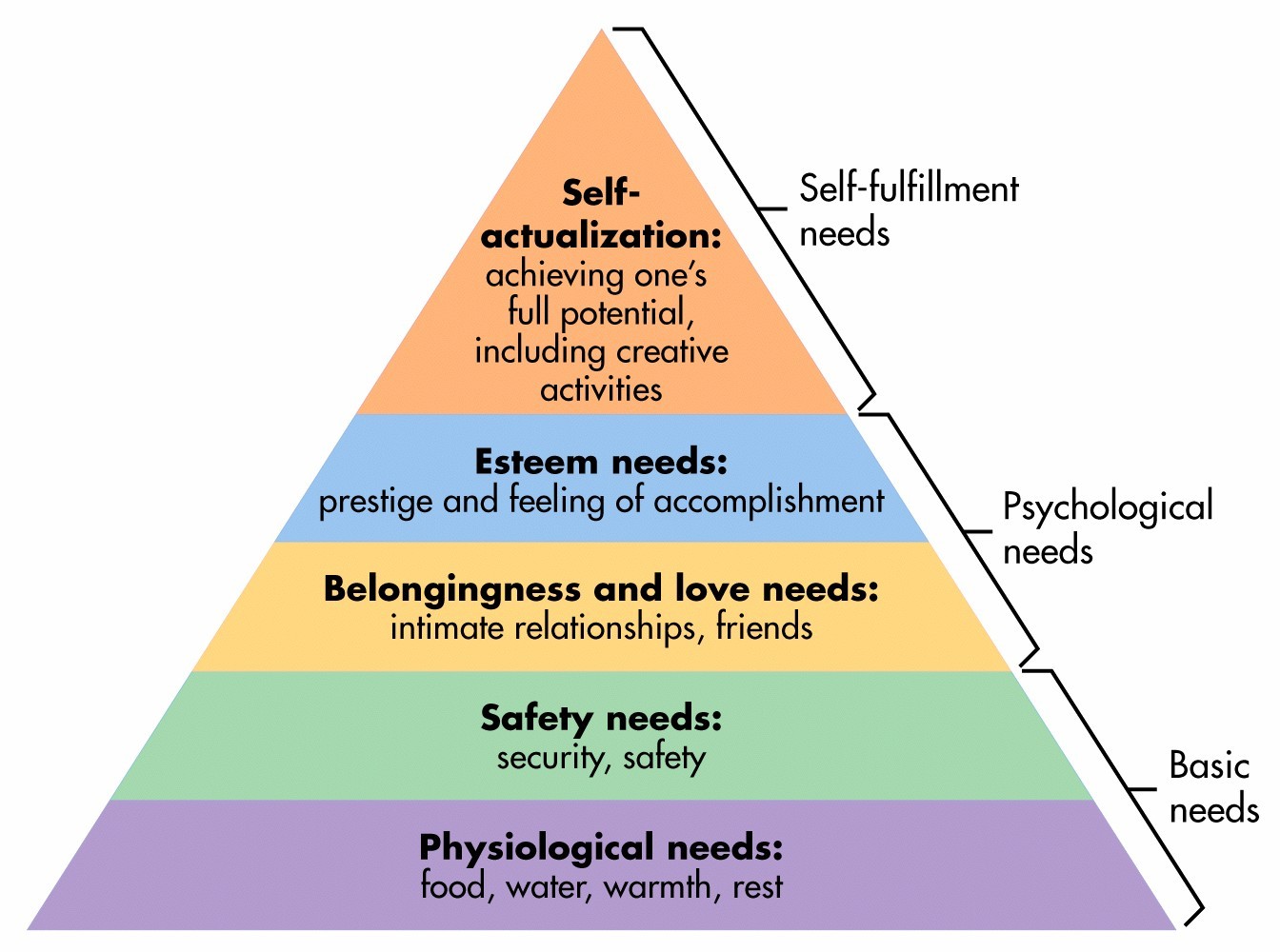
I see this pyramid as a more accurate definition of wealth. One moves to the next level of the pyramid once the previous need is fulfilled. There are still different levels that people have achieved, so the comparative element of wealth is still present. While money is still required to fulfill the first two levels, the upper levels of the pyramid make no mention of monetary wealth. They instead require relationships, and the pursuit of meaning in life. This is the true definition of wealth.

3. What are Americans’ attitudes toward wealth and poverty?

            Americans view monetary wealth as a way to distinguish between groups. The more money you have the higher your status. This is probably a fair distinction. When people have more money, they have more influence in communities, and they can control how the society is run. However, people have differing views when it comes to the political control wealthy people should have. This concern is expressed through phrases like “We are the 99%”, suggesting that the income gap between the 1% extremely wealthy and the rest of America results in a unequal distribution of power. The one percent, the minority, controls a disproportionate amount of American life. Other groups, like Republicans, believe this distribution of power is fair; those people worked to gain that kind of power and influence. However, I think every American sees the need to reduce the size of this poverty gap.       

4. What is your attitude toward wealth and poverty?

            The 99% movement is founded in truth, the income of the top 1% of America has risen drastically since the ‘70s. While it may be true that the people who have achieved that level of wealth have worked hard to get there, the growing poverty gap that this creates needs to be addressed. This can be achieved most effectively through education. By educating and encouraging kids coming from historically disadvantaged groups, educators can equip them with the tools required to be successful in the “real world”. I believe government programs are not a truly effective solution. In order to change the cycle of poverty that causes generations of families to be stuck in the same poor conditions, we must change America’s culture. We need to teach parents how to be effective nurturing parents, a tactic that can not only fulfill the needs outlined by Maslow, but can also encourage proper cognitive development in children. I believe that this will be the most effective solution in shrinking this gap in our society. Parenting techniques really do have a lasting impact on the cognitive and emotional development of children. Children raised by nurturing parents will be well equipped to succeed and break the cycle of poverty. It starts in the home!

Sunday, March 8, 2015

Translation is Absurd!


#1:As Gregor Samsa awoke one morning from uneasy dreams he found himself transformed in his bed into a gigantic insect.


  • Diction: By using the word “as”, this translation makes Samsa’s realization of the transformation take place during the transition from a sleeping to waking state. This causes the transition to be less distinct; perhaps the transformation into a bug is a waking manifestation of his “uneasy dreams”.
  • Syntax: The order of words in the latter part of this sentence is interesting: “He found himself transformed in his bed into a gigantic insect,”. By using this order instead of “he found himself in his bed, transformed into a,” the translator places emphasis on the location of the transformation, instead of the result of the transformation.
  • Imagery/details: The preterite form awake used in this translation makes for effective imagery in the line, “As Gregor Samsa awoke one morning from uneasy dreams,”. The reader can picture the normal process of waking up, undergoing the sleepy morning rituals that occur when one is in the process of awaking.
  • Structure: In this translation, the author introduces the character in the second word, “As Gregor”. This makes the readers first encounter the original identity of this character, through his name. In the words following this introduction, they see the situation the character is in, bad dreams, and a horrible transformation, but they have a chance to identify with the character before learning of the transformation,


In this translation, the translator initially introduces the readers to the main character with his name: Gregor Samsa. This allows us to quickly identify him as a normal human, like anyone else. The situation is further normalized by the process of waking up “As Gregor Samsa awoke one morning”. This allows the readers to empathize with the situation; they've been there before. And the use of “one morning” highlights that this occurred on one morning out of many comparatively normal mornings Samsa has woken up to.
From here, the line turns strange, but the translator introduces the terrifying situation gradually to the reader. He uses the word “uneasy” to describe the dreams Samsa is awaking from. This diction describes the dreams as relatively mild; not easy, but not terrifying. He then describes what he has found while awakening: that he has transformed. But the translator outlines the context of the transformation: in his bed, the connotation being that this transformation was not intentional. And finally, the diction used to describe the product of the transformation is vivid: “into a gigantic insect”. The word gigantic is extreme; it describes something of vast size. And the word insect that was chosen is relatively specific: an arthropod with six legs and usually a pair of wings, allowing for vivid imagery, and a drastic contrast from the human character presented by the name “Gregor Samsa”.


#2:Gregory Samsa woke from uneasy dreams one morning to find himself changed into a giant bug.


  • Diction: When compared to the previous translation, I notice that this translator chooses to us the phrase, “giant bug” when describing Samsa’s transformation. This is a notably less specific description; bug describes a wide range of creepie crawlies. This allows the reader to decide for themselves what form Samsa’s transformation took. Perhaps it was meant to allow readers to project their personal fears and ideas into this situation, filling in the details left blank by this ambiguous word.
  • Syntax: By placing the phrase “one morning” between “uneasy dreams" and “to find himself changed”, the translator allows some tension to build. The translator breaks up the abnormality of the situation with the normal phrase “one morning”, making the realization of the transformation more shocking.
  • Imagery/details: This translation doesn’t provide as many vivid descriptors as the other three translations do. The imagery that is available is relatively ambiguous: giant provides an element of scale to the scene, besides this, there are few visual or sensory descriptors.
  • Structure: I believe this sentence is a simple sentence with one independent clause.


By providing a more ambiguous translation, this translator allows the reader to fill in the visual and descriptive details of the situation. The imagery and details provided are sparse, especially in the description of the transformation: “giant bug”. Although this causes the opening line to be less vivid, it is perhaps truer to the original German and allows readers to draw their own conclusions.
The translator’s word choice throughout plays a role in how readers perceive the situation. To start, this translation says “Samsa woke” and then recognized the transformation, as opposed to the other translations that connect the verbs awake and found. This separation of the two actions makes the distinction between the realization and the waking process explicit; this transformation is not a waking dream, Samsa is fully awake when he notices the change. There are also no pauses in this sentence. Without commas, the reader zips through to the end realization: this man is now a bug! In my view, that’s more of a hook, no pause, just Samsa=bug!

#3:When Gregor Samsa awoke from troubled dreams one morning he found he had been transformed in his bed into an enormous bug.


  • Diction: Again in this translation, the translator describes the transformed state as “bug”, allowing for the audience to form their own image of the creature. While the previous two translations have described Samsa’s dreams as “uneasy”, this translation calls them “troubled”. This has a more negative connotation than uneasy, implying that these dreams were truly scary, and not simply uncomfortable. 
  • Syntax: This author again chooses to introduce the character within the first few words, allowing for some kind of connection before you find out, “oh he’s a bug”. 
  • Imagery/details: In this translation, the translator provides more detail, mentioning that Samsa was in the bed, and that he was an “enormous” bug This allows us to mentally compare the size of the bed to the enormous bug; an unappealing image.
  • Structure: I’m not good at this, so this may be wrong, but I think this is another simple sentence, because it is an independent clause with no commas or coordinating conjunctions.


The most significant element of this translation is the structure of the verb transform: “had been transformed”. This implies that someone or thing did the transforming. This, along with the seemingly protected environment of the transformation, the bed, creates an uneasy tone. The syntax of this translation, like the first two, provide a picture of relative normalcy at the beginning of the sentence, “awoke from troubled dreams one morning”. Once the scene is established, it is contrasted with the strangeness of the discovery.
Yet again, in this translation, there is no punctuation used beyond a period. This gives the first sentence no pause, creating an excellent hook. I think in describing the bug, this translator has found common ground, providing a generic definition of the creature, but using an adjective that still conveys the sense of dread that comes form an “enormous” bedbug.


#4:One morning, upon awakening from agitated dreams, Gregor Samsa found himself, in his bed, transformed into a monstrous vermin.


  • Diction: Wow. Monstrous vermin! That’s a change! The denotation of vermin is: wild mammals and birds that are believed to be harmful to crops, farm animals, or game, or that carry disease, e.g., foxes, rodents, and insect pests. However, this more general term also has a connotation of a person or group that is not societally acceptable.
  • Syntax: This, unlike the other three translations, places Gregor’s name after the description of him waking up. This places the name closer to the description: monstrous vermin, creating a closer connection between his previous identity and his new bug form.
  • Imagery/details: This translation is one of three that describes the location of the transformation: the bed. This provides a cringe-worthy contrast between the comfort of a bed and the horribleness of a vermin.
  • Structure: I’m unsure of the structure of this sentence, but it is the only translation that utilizes commas. This gives the reader time to think between each piece of information given. No double-take required like the other translations, you are slowly introduced to the scene, step by step.


This translation, with the use of commas and the loaded descriptor, monstrous vermin, has a more slow horror to it. The tone of the sentence is one of terror. The commas are what provide the dramatic pauses between each piece of information. It gives the sentence less of the shock value that the others have, it instead has a sense of growing dread.
And of course, the hyperbolic descriptors, “monstrous vermin” add to this tone. The word monstrous gives the insect a distinctly natural identity; its not just an oversized bug, its something worse. And the word vermin has so many societal connotations. By describing the bug as a vermin, the translator is connecting the monstrousness of the bug to the descriptor that is often used for humans in society.

Sunday, February 15, 2015

So much procrastination. So little time.

I have deliberated over whether or not to use my freebie this weekend. This really seems like a valuable exercise, and I kind of hate to miss it! I planned to use this today because I was going to be swamped with all the preemptive work I was going to do. But now, not only have I wiled away my preemptive work time, but I am also still not doing my blog post! Senioritis is not the fun, carefree sickness I though it would be.

Saturday, January 17, 2015

David Holt: The joyful tradition of Mountain Music


Video URL:

Summary:

     The joy of Music is a powerful force. It can bring people together, and keep them going through hard times. In this talk, David Holt told several stories from his life and from the Appalachian musical culture that demonstrated this point. 
     Holt’s love of music started on a hot summer day in 1954 in Gatesville Texas. His brother, mother, and him were driving in the car, and the boys were furious with their mom. She didn’t let them get the jar of Ovaltine they wanted at the grocery store, which had a toy attached. Their mom was scolding them, telling them how ungrateful they were and how “money doesn’t grow on trees”. Determined to teach her sons some work ethic, she pulled the car over to one of the cotton fields they had  been driving past. She told the foreman: “I've got these two little boys, never worked a day in their lives.” So she asked the foreman to put them to work picking cotton and filling up a ten foot sack, alongside the hundred black workers in the field. He did as he was asked, and the boys worked all day picking the prickly, painful plants. At first they cried to their mother, who watched with an uncompromising gaze. Trying to ease their discomfort, the foreman snuck up behind them and began to sing an uplifting tune: “good news good news, a chariot’s a comin’”. The field of workers joined in, and the boys stop complaining as they were surrounded by these beautiful songs. This showed how music can make hard work a bit easier, and how it can bring a group of people together, in a unique way.
     About 15 years later, while attending the University of California at Santa Barbara, Holt attended a concert by Ralph Stanley, a famous banjo player. After seeing it in action, Holt fell in love with the African claw-hammer banjo technique. He sought out Stanley after the concert and asked how he could be involved with that kind of music, and Stanley told him to go to Asheville, Clinch Mountain, or anywhere where there is a lot of music. There will be old people still playing that style. So he went, and fell in love with the culture and people. He met people living with no electricity or running water, but who carried on the traditions of Appalachia through their storytelling and music. 
     One such person was Aunt Zip, from Sodom, North Carolina. She was 105 when he met her, and together, they sang a song that she had written. She didn’t have much energy left, so he led her in the call: “Hey Hey” and she would give the response: “Black-eyed Susie”. On her small farm, her grandson was tilling the fields with the mule, and Holt and Aunt Zip sang together. People like this embodied the persistent joy that comes from this music of the mountains. When he came back home, he finished his two degrees in biology and art, and told his parents he wanted to be a banjo player.
     Later on, this same joy from music saved Holt’s life. 15 years ago, he and his wife lost their daughter, Sarah Jane, in a car accident. After this immense loss, Holt was just barely hanging on. He was staring into the abyss, and desperately searching for reasons not to jump in. He started making lists of reasons to stay in this world. He started with the big things: his son, wife, and parents. But after this, only seemingly insignificant details were added to his list. Things like seeing the daffodils bloom in the spring, the touch of a baby’s hand, and finally, the sound of the steel guitar. This was the only instrument that could fully convey the emotion he was feeling. A blues tune on his steel guitar arose from his sadness, and it was the music he immersed himself in that got him through this hard time.
     Holt closed out his talk by talking about the lighthearted things of his life; childhood stories, experiments, and games. He finished his speech by showing the audience a device he had made with the advent of drum triggers. He took a full body suit and sewed in 12 different pressure sensitive drum triggers. He played ancient hambone rhythms on this unique, hilarious looking instrument, slapping his thighs, arms and chest to create an immersive sound. The talk ended with this “thunder-suit” solo, and the audience’s laughter and cheers.

Analysis:

Purpose:
     Although this TED talk wasn’t necessarily meant to do anything more than inform and entertain the audience, for the purpose of this analysis, I will view the tactics used in Holt’s talk as tools to persuade the audience to see the power of music. This was likely an underlying motivation, but it was never explicitly stated.

Ethos:
     David Holt is a four time Grammy-winning musician, who plays ten acoustic instruments and hosts radio and television shows on early American folk tales and music. These amazing credentials give Holt more than enough authority to talk about the subject of mountain music. However, these are not explicitly stated in his talk, so Holt finds other ways to establish credibility. He does this primarily by demonstrating the music connected to his stories throughout his speech. He treats the audience to several songs, playing the steel guitar, harmonica, banjo, and singing beautifully. By interjecting real snippets of the Mountain Music he is talking about, he establishes his expertise on the subject of Appalachian music. His personal examples and stories also display his proximity to and in-depth understanding of the effect of music on people. You can talk about the beauty and influence of music until the cows come home, but if you don’t have a lick of musical ability, it’ll be far more difficult to establish authority on the subject.

Logos:
     The main purpose of these stories was to show how music can get people through hard times and bring people together. Consequently, an emotional appeal will be used the most often to prove this point. However, throughout his speech, Holt uses a few logical approaches to further his argument. This is found mostly in the use of specific examples. As in any argument, it is important to back up theoretical ideas with specific real world examples. Holt does this by displaying the positive power of music by telling tales of the effect of music on his childhood, in his adult life, and in the lives of Appalachian people. However, the majority of the examples were experienced by him personally, a professional musician, and therefore interpreted through a pro-music lens. Holt’s argument might've been enhanced by a brief historical exploration of the effect of music on the culture of Appalachia, or the biological effects of exposure to music.

Pathos:
     Music is inherently emotional, triggering the release of neurotransmitters like dopamine throughout the brain, which causes an visceral emotional response. Therefore, an emotional appeal was the most common appeal used by Holt in his stories. He played music throughout the talk to display the emotional effect of music. But he also used emotional examples  to convince the audience of music’s positive effects. From humorous stories of his childhood to the sadness he experienced following the death of his daughter, Holt shows the influence of music on the wide range of human emotion.

My Connection: 
     I chose this talk because I have always enjoyed bluegrass music. This interest in the music of the Appalachian mountains started at my grandparent’s house. Every Friday night that we stay at their house in Warrensville, NC, we go down to Phipps Store to listen to some of the best local pickers. Not nose pickers, but pickers of the mandolin, banjo, dulcimer, etc. We sit in the small crowd listening to the impromptu jam sessions, and watching people clogging to the beat. The culture found in these old, rolling mountains is fascinating, and has given birth to one of the most  popular America genres of music, bluegrass. Originally played on makeshift fiddles and banjos, this music has offered people living in the mountains an escape and creative outlet for centuries. I love Holt’s professional mission: to preserve this musical tradition; it was an influential chapter in America’s musical history, and it deserves recognition and appreciation.

Sunday, December 7, 2014

"Come, you spirits-- Netflix me here"

Watched by Lady Macbeth:

House of Cards:
Claire Underwood, played by Robin Wright. "Out damned spot!" (Macbeth)

In this political masterpiece, the South Carolina senator Frank Underwood maneuvers his way through the top American bureaucracy: Congress. With each ethically questionable decision he makes, he gains more and more power. His wife, Carrie Underwood is an equally influential person in the D.C. area. She supports him every choice he makes, pushing him to make the most of his position to gain more influence. Though he would never admit it, most of Frank’s decisions are influenced by his wife's encouragement and convincing arguments. Lady Macbeth has truly enjoyed watching Carrie playing a powerful role in American politics, while at the same time maintaining conventional gender roles, working through her husband's image. By her own admittance, she is often guilty of shouting: "Thoust goest girl!" at Claire Underwood's influential and clever words. She has a way of planting vaulting ambition in the heart of her husband. This ambition will increase his power, and consequently, her influence and status. Lady Macbeth loves it, and has gotten a few ideas for her own marriage from this show.

Madmen:
Peggy Olson, played by Elizabeth Moss, and Joan Holloway, played by Kristina Hendricks

In the bustling, cut-throat world of 1950's advertising, Madmen follows the journey of creative genius Don Draper. The agency he works in is filled with alcohol, tobacco, and sexism. The women working there are constantly subjected to shameless objectification by the male copywriters of the office. Most woman work as secretaries and phone operators; there is very little mobility for women. There are two powerful exceptions, however. Peggy and Joan defy the gender roles of the office in their respective positions, and they struggle with being viewed as masculine because of this. Watching their journey through a sea of power-hungry men is inspirational for Lady Macbeth. She is able to see the progression of feminine influence in the office, and she empathizes with the conflicts of these two characters especially. When Peggy is accused of being masculine, she cringes: she's been there before. But when Peggy and Joan triumph over the stigmas against women, she rejoices. A powerful, influential woman like herself has a chance to increase in status as a result of her own actions.  

Frozen:
Elsa, voiced by Indina Menzel

Lady Macbeth hates snow, but she loves this movie. Frozen is the story of Elsa, a powerful queen who must hide her true identity. Finally, when her powers are revealed, she runs off into the mountains of the Netherlands, to fully realize her potential. She sings "Let it Go", an anthem broadcasting release of her fantastical powers. However, this expression of power eventually hurts her younger sister. She is struck by a release of ice from Elsa, an unintended side-effect of her personal liberation. Elsa then deals with the immense guilt of this event; she must redeem herself of her sister's sickness. Lady Macbeth deals with a similar guilt. She fully understands Elsa's expression of power through her actions and the consequent guilt when things go too far. She loves the redemption Elsa receives at the end, and she hopes that she too can be free from guilt. Maybe the snow can wash away her stains as well.
  
The Hunger Games
Katniss Everdeen, played by Jeniffer Lawrence

Based off of the extremely popular series by Suzanne Collins, this movie follows the life of Katniss, a girl from district 12. She volunteers to be a part of the “Hunger Games” a government organized game that forces 24 young people to fight to the death like teenage gladiators, and only one emerges as a victor. Throughout the games, we see Katniss struggle with fear, murder, and consequent guilt. Katniss works with her significant other, Peeta to win the games. In the end, they are the only two “tributes” left. Instead of killing each other, they both choose to commit suicide together. This act of devotion stops the games, and they are both victors. Lady Macbeth loves the love story of this movie; she can’t get enough of the Katniss, Peeta dynamic. But she especially sympathizes with their situation. They are both working together to kill off their opponents, one by one. The guilt of their deaths slowly builds, but they simply can’t go back until they are unopposed. In the end, they choose to end their misery in death.  


Sunday, November 16, 2014

Mawiage Is What Bwings Us Togeva Today

Big things are happening today, a question is being asked. It's cray over at the McClure household, so I'm gonna take a FREEBIE!

P.S.
The question starts with "Will you" and ends with "Marry me"
My Sister is involved so is her boyfriend.

Sunday, October 26, 2014

Limited Visibility

89 Huicholes, 2006,  By Santiago Sierra. 84 black and white portraits.

Initial Response:
                Limited Visibility is an exhibit that emphasizes the effect and meaning behind intentional erasure and omission. The manifestation of these absences varies in each work, and the purpose behind the omission has different intended effects on the viewer. The Curators statement explained this exhibits impact: “Seer, seen, and unseen come together here to evoke the haunted sensation of searching and looking.” With the curators introduction as a guideline for my thoughts, I was able to search for the omission of each piece, and ponder the significance of absence.
                Each works omission gave me unique feelings. 97 Housemaids, by Daniela Ortiz, showed pictures collected from Facebook that centered on upper-class Peruvian families. The maids and workers were cut out or in the background. Though not intentional, the pictures depicted a heart-wrenching truth about the relationships between different social classes. Other works were less straightforward and required personal interpretation. A site-specific piece, Unfolded Architecture by Pablo Rasgado, showed a square of deconstruction. The omission of the sheetrock and plywood didnt have a clear message, but it stirred in me a feeling of loss and impermanence. But perhaps the destruction of the old is necessary for the advent of the new. Other pieces had absent ideas, like the missing labor in Allora & Calzadillas sandpaper composition. This could represent a seeming disregard for the months of work the sandpaper was used for. Each piece had a unique message and a clear theme. “Limited Visibility” was a straightforward, but at times challenging concept. As an art novice, I was excited and surprised by the ideas I gleaned from things that were missing.

Visual Analysis:
                The piece that I have chosen to analyze is a collection of 84 black and white photographs by Santiago Sierra. It is called 89 Huicholes, and was made in 2006. Santiago is an artist from Spain, and many of his works express some sort of message for social change. In this piece, Santiago has compiled 84 portraits of members of the Huicholes tribe. These photographs, however, defy the conventional portrait form. The members of the tribe all have their backs to us. We can see the occasional neck, headdress, and hair, but their faces are hidden. Most portraits emphasize the face as the defining feature to be depicted, but Santiago views the back, or omission of the face as a significant representation of the individuals. These portraits are all similar, most with only one subject, but a few with an unseen mother and child. They are all depicted in black and white. This lack of color works to draw the attention to minute differences between each picture. Without distracting colors, the viewer is not overwhelmed by the display, and is able to analyze each individual. Each picture is in portrait orientation, and they are organized into 5 rows. The four top rows each have 17 pictures, but the bottom most row has only 16; there is an empty space in the bottom right corner. This is another example of purposeful omission, in line with the theme of the exhibit.
                In a society that highly values image and exposure, this piece is a culture shock. Viewing pictures that purposely omit the face is surprising, and extremely impactful. Even as we perused the exhibit, phones were out, pictures were being snapped and instantly posted. To look in on the starkly contrasting culture of the Huicholes is humbling. One of the last tribes in North America who still practice their pre-Columbian traditions, the Huicholes are constantly fighting against the government and farmers to maintain their religious practices and ancestral land rights. By having their backs to the viewer, this piece invokes a sense of guilt. Perhaps this is the only thing we ever see of the Huicholes, we live in ignorance of their existence. Could these pictures represent the highest level of exposure that their conditions and culture will ever receive?
                Even from behind, we can see that the subject of each portrait has a unique personality and attributes. This is seen in the way they choose to organize their hair, headdresses, and clothes. Their body position may indicate their psychological or physical condition. The viewer is forced to utilize what they are given to form a complete picture of the individual. Santiago describes this: "The person has to create what the person doesn't see". The viewer is not spoon-fed the picture, they instead must actively pursue the image of the individual. Without the face of the subjects being shown, only so much can be assumed about them. Although the viewer is keenly aware of the subject's individuality, they can't truly know the person from the light that has been captured and displayed. This may represent the tragedy of the unnoticed, unseen. There are people around the world that are unique, special, in need of help, but never noticed. They are never given the opportunity to communicate, be seen, and shown. The Huicholes are in this condition, and Santiago displays this in 89 Huicholes. We need to notice those being oppressed and silenced. We should take a break from absorbing the publicized, and instead actively pursue the things not being shown. By seeking out those whose backs are turned, we can have a positive impact on their lives. By changing our mentality, perhaps we can alter the culture to pursue engagement and active pursuit; as opposed to inactively viewing the things we are shown.
                The empty space in the bottom right corner of this work is another purposeful omission by Santiago. This space is perhaps meant to be filled by the people the viewer knows that are ignored. Individuals or cultures that are bypassed and oppressed, or maybe even the viewer him/herself feels that they would fit in this space. The empty space allows the message of the work to go beyond just the Huicholes. This ignored identity is seen around the world; the oppression of the Huicholes is an example of this universal principle. As I viewed this piece, I thought of the people I ignore and dismiss, and even those who I have never met or heard of, and I added them to this gap.