Sunday, April 19, 2015

I Was--It Was

It was OR I was

I was sitting in church a few Sundays ago,
And my attention wasn’t focused on the pastor…

I was instead concentrating on my breathing.
I was thinking about my diaphragm contracting,
Increasing the volume of my thoracic cavity, allowing air to flow in
Down the concentration gradient, from the high pressure of outside, into my lungs.
The oxygen from this air was absorbed into the blood through the alveoli,
And the blood traveled down the pulmonary vein to that big lump of muscle,
My heart.

Oh how my heart beats!
(I know how it beats; the Sino-atrial node sends an electric pulse to stimulate coronary muscle)
Oh how my blood flows!
(I know how it flows; from veins to the right atrium, then the right ventricle, and then through the arteries.)
Oh how my muscles move!
(I know how they move; calcium floods the sarcomere, causing proteins on the actin filament to move and allow the myosin heads to attach to actin filaments).

I was definetly not focused.
But this knowledge had some intrinsic value as I sat in the sanctuary.
I then thought of the sensations these omnipresent physiological processes allow.
They let us move, breathe, smell, see, hear, feel, laugh, remember, eat, poop
What a blessing!
At this most basic level, I didn’t know where to direct my gratitude.
I have a lot of thanks built up, and it is precious to me.
I don’t want to waste it.

So, I’ll thank the people I know can hear me.
The ones that I have shared these experiences with.

It was fun to laugh until it hurt with Marin in World Religions last year.
It was good (but a bit scary) to get way too competitive in Pictionary. (Sorry Abby)
It was hard to go to a memorial service for a grieving friend and family.
It was exciting to learn about and investigate the world through my teachers.
It was stressful to plan out my next four years.
It was hilariously difficult to fight off senioritis (still is)
It was cathartic to sing and act with a group of like-minded peers.
It was depressing to read our novels (1984, The Stranger, Woman at Point Zero)
It was necessary to be exposed to hard concepts (1984, The Stranger, Woman at Point Zero)
It was sweet to build life-long friendships with a group of awesome teenagers.

This list is not exhaustive, but I am exhausted.
Thanks for the memories!
(And the ones to come, I’m realizing that we still have more school)
(Which is a good thing)
(Right?)


Sunday, April 5, 2015

Walt Whitman: The Bohemian's Rhapsody

Whitman’s Journal:

            On the first page of Whitman’s journal, it looks like he has written several people’s addresses. It starts with a name, “M Lenan”, and then lists an address, “81 Cleremont Av.” He then begins with his big idea, under the heading, “Brochure”: “Two characters as of a dialogue between A. Lincoln and ‘Someone’” (it probably said Whitman). On these first two pages, and on others scattered throughout the notebook, there are stamps that read “Library of Congress”. I feel like that was a later addition however. Probably from the library of Congress. Hmm. During the first page of written script, Whitman seems to be wrestling topics about religion, philosophy, and Christianity specifically. He is choosing the order of his words carefully, crossing out words that don’t apply, and completing his thoughts in the margins. After this page, however, he begins to delve into poetry. With this change in the kind of writing, his script becomes more confident. He uses metaphors, like in the “Ship of Libertad,” to represent the journey of his philosophy. Throughout the poem, he is commanding the “clouds of death”, and the “mad winds”, to “tug at the planks” of the Ship, because he wants to “see what stuff you (Ship of Libertad) are made of,”. This entire poem seems optimistic. He believes in the power of this ship, the, “Ship of the world—Ship of Humanity—Ship of Promise,” His writing process is revealed in this poem as well. Periodically, he will include a small question mark instead of a word, “Let them ?”, perhaps to be filled in later with a phrase he needs to think about.
            In these first four pictures, I think Whitman is illustrating the main characters of his dialogue, himself and Lincoln. The first two look like pictures I have seen of him, and his first portrait seems less like a caricature than the second. This perhaps shows his comfort with portraying himself in a foolish light. The two other pictures are far more serious, as they portray Lincoln, with his classic top hat. The picture after that is way out of my depth. It looks at first glance like a pioneer woman’s head covering, but also a little bit like a goose, so I’m not sure. And wow. This last picture with the skeleton is pretty cool, but slightly sad. It is a gruesome picture, a skeleton being stabbed by a sword in his oversized heart. But the skeleton is giving us a shrug of acceptance, and the landscape is beautiful. It provides an ironic contrast, maybe to display the beauty of death.

Additional Thoughts:

            Ah, I was wondering what he meant by those “two religious—platforms”. According to this, he wished to reconcile slaveholders into the Union, and so wanted a new., all encompassing “third religion,” which embraced “that which is not conscience, but against it,”. He wishes to not exclude whatever philosophy or idea exists. The first post-modernist? He intentionally used the Spanish word “Libertad”, which I suspected. I felt like it couldn’t have just been a persistent misspelling. I had thought that this Libertad represented some American Ideal, but I didn’t realize that the Ship Libertad was meant to represent the struggle of America during the Civil War.
            So these sketches weren’t by Whitman, interesting. However, these notes point out that he enjoyed having his portrait drawn. Apparently all four of the pictures of people were portraits of himself. The hat he wore that reminded me of Lincoln was a part of his signature bohemian look. Oh snap. This picture that I thought was a goose or pioneer woman is actually a harp! Wow, I’m embarrassed. And the mysterious skeleton man is just that, a mystery. The historians think it could represent the halfway state of America at this time, suspended “between day and night, life and death,”.

Saturday, March 14, 2015

The American Dream

1. How would you describe the “American Dream?”

            The American dream embodies itself in many different ways. However, when I hear the words “American Dream”, I can’t help but think of an idealistic, picturesque lifestyle. There is a small white house with green shutters in a quiet, suburban neighborhood.  An old oak tree shades the front lawn, complete with a small tire swing. A substantially large city is about 25 minutes away, where my family and I go on the weekends to spend our hard-earned money, stimulating the local economy.  There’s a diverse, effective school to send the kids to, and a church to get involved in. This kind of white picket fence environment is not universal throughout America, but the guiding principles that allow for this lifestyle are universal. America’s founding documents allow for a capitalist economy, freedom of religion, and free education, to name a few. Therefore, in my view this American dream is allowed because of the freedom provided by democracy. The ability to freely express ideas, practice religion, and elect our leaders allows American citizens to build a life that suits them, and it will hopefully allow me to live in this small suburban home one day!

2. What is your definition of wealth?

            Money. Material gain. How many yachts you have. These things describe wealth. By this measure, I am far from wealthy. My two door ’96 Honda civic doesn’t constitute a fancy sports car, and my savings account is abysmally empty.       
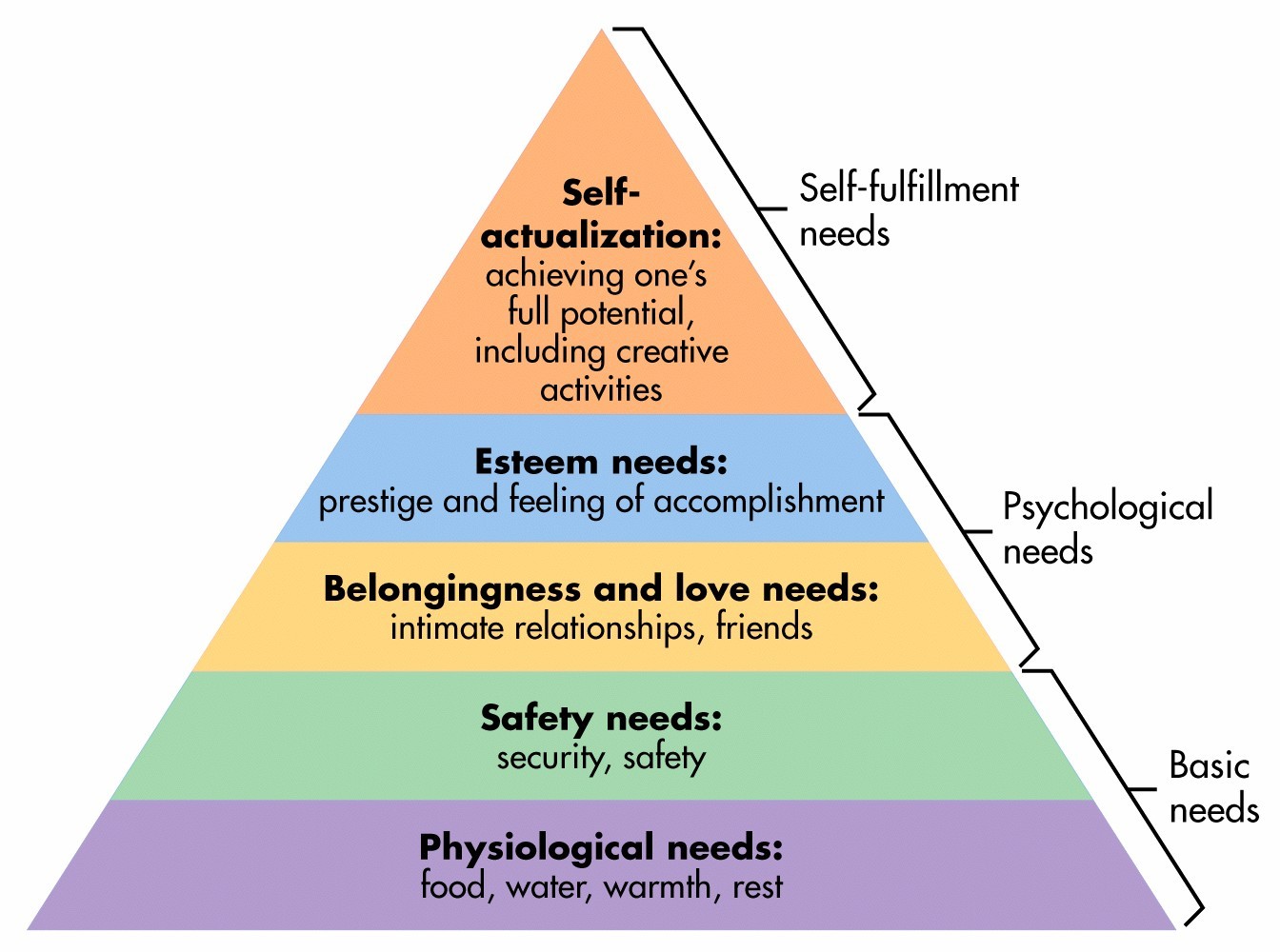
             That was mostly a joke. I believe wealth is more effectively measured by another metric. It should be defined in a non-materialistic way; a measure of the depth of relationships one has and the meaning of one’s life. According to this concept, I am relatively wealthy. Maslow described this idea in his “hierarchy of needs”.

I see this pyramid as a more accurate definition of wealth. One moves to the next level of the pyramid once the previous need is fulfilled. There are still different levels that people have achieved, so the comparative element of wealth is still present. While money is still required to fulfill the first two levels, the upper levels of the pyramid make no mention of monetary wealth. They instead require relationships, and the pursuit of meaning in life. This is the true definition of wealth.

3. What are Americans’ attitudes toward wealth and poverty?

            Americans view monetary wealth as a way to distinguish between groups. The more money you have the higher your status. This is probably a fair distinction. When people have more money, they have more influence in communities, and they can control how the society is run. However, people have differing views when it comes to the political control wealthy people should have. This concern is expressed through phrases like “We are the 99%”, suggesting that the income gap between the 1% extremely wealthy and the rest of America results in a unequal distribution of power. The one percent, the minority, controls a disproportionate amount of American life. Other groups, like Republicans, believe this distribution of power is fair; those people worked to gain that kind of power and influence. However, I think every American sees the need to reduce the size of this poverty gap.       

4. What is your attitude toward wealth and poverty?

            The 99% movement is founded in truth, the income of the top 1% of America has risen drastically since the ‘70s. While it may be true that the people who have achieved that level of wealth have worked hard to get there, the growing poverty gap that this creates needs to be addressed. This can be achieved most effectively through education. By educating and encouraging kids coming from historically disadvantaged groups, educators can equip them with the tools required to be successful in the “real world”. I believe government programs are not a truly effective solution. In order to change the cycle of poverty that causes generations of families to be stuck in the same poor conditions, we must change America’s culture. We need to teach parents how to be effective nurturing parents, a tactic that can not only fulfill the needs outlined by Maslow, but can also encourage proper cognitive development in children. I believe that this will be the most effective solution in shrinking this gap in our society. Parenting techniques really do have a lasting impact on the cognitive and emotional development of children. Children raised by nurturing parents will be well equipped to succeed and break the cycle of poverty. It starts in the home!

Sunday, March 8, 2015

Translation is Absurd!


#1:As Gregor Samsa awoke one morning from uneasy dreams he found himself transformed in his bed into a gigantic insect.


  • Diction: By using the word “as”, this translation makes Samsa’s realization of the transformation take place during the transition from a sleeping to waking state. This causes the transition to be less distinct; perhaps the transformation into a bug is a waking manifestation of his “uneasy dreams”.
  • Syntax: The order of words in the latter part of this sentence is interesting: “He found himself transformed in his bed into a gigantic insect,”. By using this order instead of “he found himself in his bed, transformed into a,” the translator places emphasis on the location of the transformation, instead of the result of the transformation.
  • Imagery/details: The preterite form awake used in this translation makes for effective imagery in the line, “As Gregor Samsa awoke one morning from uneasy dreams,”. The reader can picture the normal process of waking up, undergoing the sleepy morning rituals that occur when one is in the process of awaking.
  • Structure: In this translation, the author introduces the character in the second word, “As Gregor”. This makes the readers first encounter the original identity of this character, through his name. In the words following this introduction, they see the situation the character is in, bad dreams, and a horrible transformation, but they have a chance to identify with the character before learning of the transformation,


In this translation, the translator initially introduces the readers to the main character with his name: Gregor Samsa. This allows us to quickly identify him as a normal human, like anyone else. The situation is further normalized by the process of waking up “As Gregor Samsa awoke one morning”. This allows the readers to empathize with the situation; they've been there before. And the use of “one morning” highlights that this occurred on one morning out of many comparatively normal mornings Samsa has woken up to.
From here, the line turns strange, but the translator introduces the terrifying situation gradually to the reader. He uses the word “uneasy” to describe the dreams Samsa is awaking from. This diction describes the dreams as relatively mild; not easy, but not terrifying. He then describes what he has found while awakening: that he has transformed. But the translator outlines the context of the transformation: in his bed, the connotation being that this transformation was not intentional. And finally, the diction used to describe the product of the transformation is vivid: “into a gigantic insect”. The word gigantic is extreme; it describes something of vast size. And the word insect that was chosen is relatively specific: an arthropod with six legs and usually a pair of wings, allowing for vivid imagery, and a drastic contrast from the human character presented by the name “Gregor Samsa”.


#2:Gregory Samsa woke from uneasy dreams one morning to find himself changed into a giant bug.


  • Diction: When compared to the previous translation, I notice that this translator chooses to us the phrase, “giant bug” when describing Samsa’s transformation. This is a notably less specific description; bug describes a wide range of creepie crawlies. This allows the reader to decide for themselves what form Samsa’s transformation took. Perhaps it was meant to allow readers to project their personal fears and ideas into this situation, filling in the details left blank by this ambiguous word.
  • Syntax: By placing the phrase “one morning” between “uneasy dreams" and “to find himself changed”, the translator allows some tension to build. The translator breaks up the abnormality of the situation with the normal phrase “one morning”, making the realization of the transformation more shocking.
  • Imagery/details: This translation doesn’t provide as many vivid descriptors as the other three translations do. The imagery that is available is relatively ambiguous: giant provides an element of scale to the scene, besides this, there are few visual or sensory descriptors.
  • Structure: I believe this sentence is a simple sentence with one independent clause.


By providing a more ambiguous translation, this translator allows the reader to fill in the visual and descriptive details of the situation. The imagery and details provided are sparse, especially in the description of the transformation: “giant bug”. Although this causes the opening line to be less vivid, it is perhaps truer to the original German and allows readers to draw their own conclusions.
The translator’s word choice throughout plays a role in how readers perceive the situation. To start, this translation says “Samsa woke” and then recognized the transformation, as opposed to the other translations that connect the verbs awake and found. This separation of the two actions makes the distinction between the realization and the waking process explicit; this transformation is not a waking dream, Samsa is fully awake when he notices the change. There are also no pauses in this sentence. Without commas, the reader zips through to the end realization: this man is now a bug! In my view, that’s more of a hook, no pause, just Samsa=bug!

#3:When Gregor Samsa awoke from troubled dreams one morning he found he had been transformed in his bed into an enormous bug.


  • Diction: Again in this translation, the translator describes the transformed state as “bug”, allowing for the audience to form their own image of the creature. While the previous two translations have described Samsa’s dreams as “uneasy”, this translation calls them “troubled”. This has a more negative connotation than uneasy, implying that these dreams were truly scary, and not simply uncomfortable. 
  • Syntax: This author again chooses to introduce the character within the first few words, allowing for some kind of connection before you find out, “oh he’s a bug”. 
  • Imagery/details: In this translation, the translator provides more detail, mentioning that Samsa was in the bed, and that he was an “enormous” bug This allows us to mentally compare the size of the bed to the enormous bug; an unappealing image.
  • Structure: I’m not good at this, so this may be wrong, but I think this is another simple sentence, because it is an independent clause with no commas or coordinating conjunctions.


The most significant element of this translation is the structure of the verb transform: “had been transformed”. This implies that someone or thing did the transforming. This, along with the seemingly protected environment of the transformation, the bed, creates an uneasy tone. The syntax of this translation, like the first two, provide a picture of relative normalcy at the beginning of the sentence, “awoke from troubled dreams one morning”. Once the scene is established, it is contrasted with the strangeness of the discovery.
Yet again, in this translation, there is no punctuation used beyond a period. This gives the first sentence no pause, creating an excellent hook. I think in describing the bug, this translator has found common ground, providing a generic definition of the creature, but using an adjective that still conveys the sense of dread that comes form an “enormous” bedbug.


#4:One morning, upon awakening from agitated dreams, Gregor Samsa found himself, in his bed, transformed into a monstrous vermin.


  • Diction: Wow. Monstrous vermin! That’s a change! The denotation of vermin is: wild mammals and birds that are believed to be harmful to crops, farm animals, or game, or that carry disease, e.g., foxes, rodents, and insect pests. However, this more general term also has a connotation of a person or group that is not societally acceptable.
  • Syntax: This, unlike the other three translations, places Gregor’s name after the description of him waking up. This places the name closer to the description: monstrous vermin, creating a closer connection between his previous identity and his new bug form.
  • Imagery/details: This translation is one of three that describes the location of the transformation: the bed. This provides a cringe-worthy contrast between the comfort of a bed and the horribleness of a vermin.
  • Structure: I’m unsure of the structure of this sentence, but it is the only translation that utilizes commas. This gives the reader time to think between each piece of information given. No double-take required like the other translations, you are slowly introduced to the scene, step by step.


This translation, with the use of commas and the loaded descriptor, monstrous vermin, has a more slow horror to it. The tone of the sentence is one of terror. The commas are what provide the dramatic pauses between each piece of information. It gives the sentence less of the shock value that the others have, it instead has a sense of growing dread.
And of course, the hyperbolic descriptors, “monstrous vermin” add to this tone. The word monstrous gives the insect a distinctly natural identity; its not just an oversized bug, its something worse. And the word vermin has so many societal connotations. By describing the bug as a vermin, the translator is connecting the monstrousness of the bug to the descriptor that is often used for humans in society.