1. How would you describe the
“American Dream?”
The
American dream embodies itself in many different ways. However, when I hear the
words “American Dream”, I can’t help but think of an idealistic, picturesque
lifestyle. There is a small white house with green shutters in a quiet,
suburban neighborhood. An old oak tree
shades the front lawn, complete with a small tire swing. A substantially large
city is about 25 minutes away, where my family and I go on the weekends to spend
our hard-earned money, stimulating the local economy. There’s a diverse, effective school to send
the kids to, and a church to get involved in. This kind of white picket fence
environment is not universal throughout America, but the guiding principles
that allow for this lifestyle are universal. America’s founding documents allow
for a capitalist economy, freedom of religion, and free education, to name a
few. Therefore, in my view this American dream is allowed because of the
freedom provided by democracy. The ability to freely express ideas, practice
religion, and elect our leaders allows American citizens to build a life that
suits them, and it will hopefully allow me to live in this small suburban home
one day!
2. What is your definition of
wealth?
Money.
Material gain. How many yachts you have. These things describe wealth. By this
measure, I am far from wealthy. My two door ’96 Honda civic doesn’t constitute
a fancy sports car, and my savings account is abysmally empty.
That was mostly a joke. I believe wealth is more effectively
measured by another metric. It should be defined in a non-materialistic way; a
measure of the depth of relationships one has and the meaning of one’s life.
According to this concept, I am relatively wealthy. Maslow described this idea
in his “hierarchy of needs”.
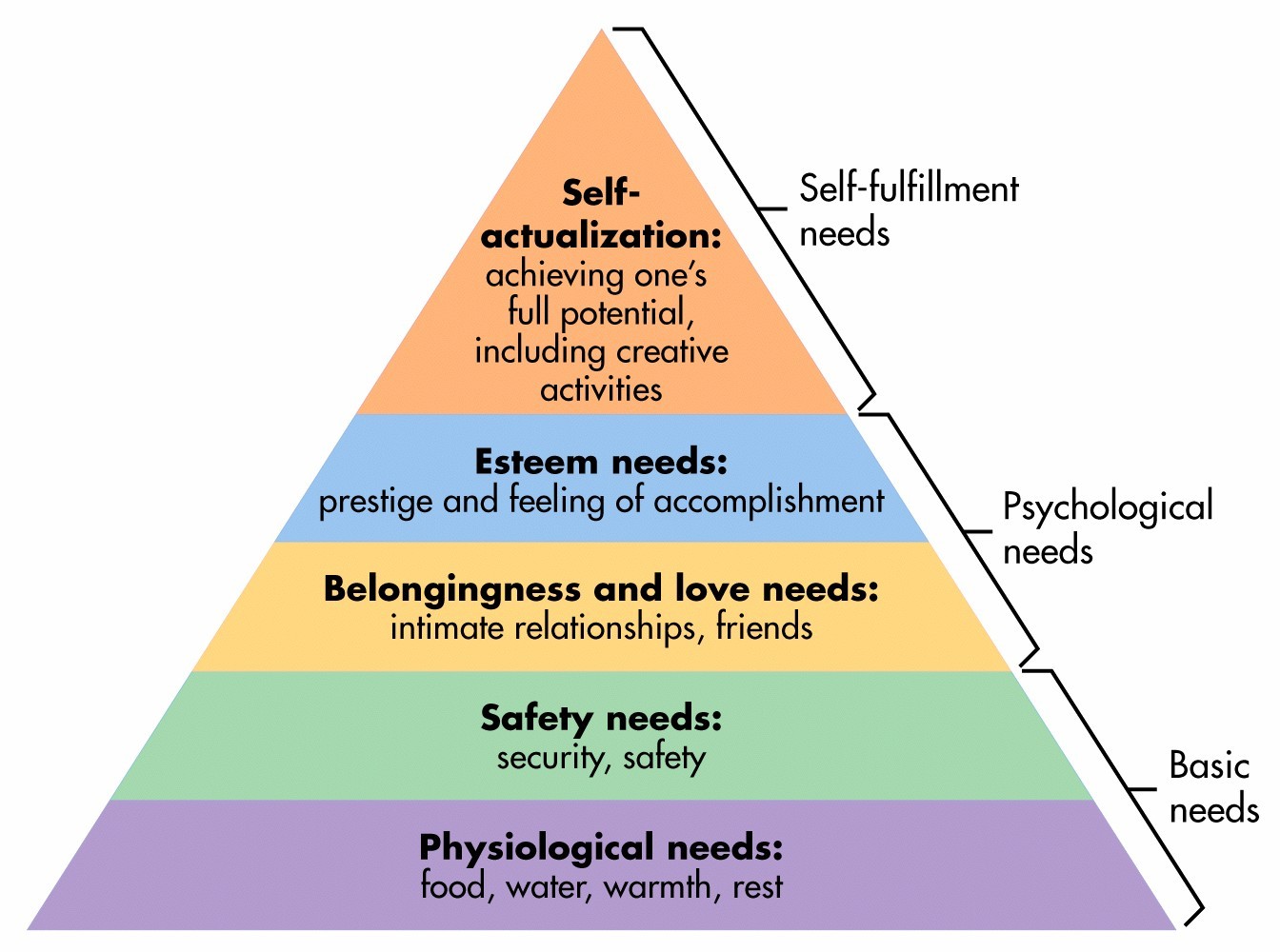
I see this pyramid
as a more accurate definition of wealth. One moves to the next level of the
pyramid once the previous need is fulfilled. There are still different levels
that people have achieved, so the comparative element of wealth is still
present. While money is still required to fulfill the first two levels, the
upper levels of the pyramid make no mention of monetary wealth. They instead
require relationships, and the pursuit of meaning in life. This is the true
definition of wealth.
3. What are Americans’ attitudes toward wealth and poverty?
Americans
view monetary wealth as a way to distinguish between groups. The more money you
have the higher your status. This is probably a fair distinction. When people
have more money, they have more influence in communities, and they can control
how the society is run. However, people have differing views when it comes to
the political control wealthy people should have. This concern is expressed
through phrases like “We are the 99%”, suggesting that the income gap between
the 1% extremely wealthy and the rest of America results in a unequal
distribution of power. The one percent, the minority, controls a
disproportionate amount of American life. Other groups, like Republicans,
believe this distribution of power is fair; those people worked to gain that
kind of power and influence. However, I think every American sees the need to reduce
the size of this poverty gap.
4. What is your attitude toward
wealth and poverty?
The
99% movement is founded in truth, the income of the top 1% of America has risen
drastically since the ‘70s. While it may be true that the people who have
achieved that level of wealth have worked hard to get there, the growing
poverty gap that this creates needs to be addressed. This can be achieved most
effectively through education. By educating and encouraging kids coming from
historically disadvantaged groups, educators can equip them with the tools
required to be successful in the “real world”. I believe government programs
are not a truly effective solution. In order to change the cycle of poverty
that causes generations of families to be stuck in the same poor conditions, we
must change America’s culture. We need to teach parents how to be effective
nurturing parents, a tactic that can not only fulfill the needs outlined by
Maslow, but can also encourage proper cognitive development in children. I
believe that this will be the most effective solution in shrinking this gap in
our society. Parenting techniques really do have a lasting impact on the
cognitive and emotional development of children. Children raised by nurturing
parents will be well equipped to succeed and break the cycle of poverty. It
starts in the home!

